Insights
Muse, Instinct, Dots… The coming wave of AI Personal Assistants could shut down healthcare. Or it could solve the $28B patient engagement problem.
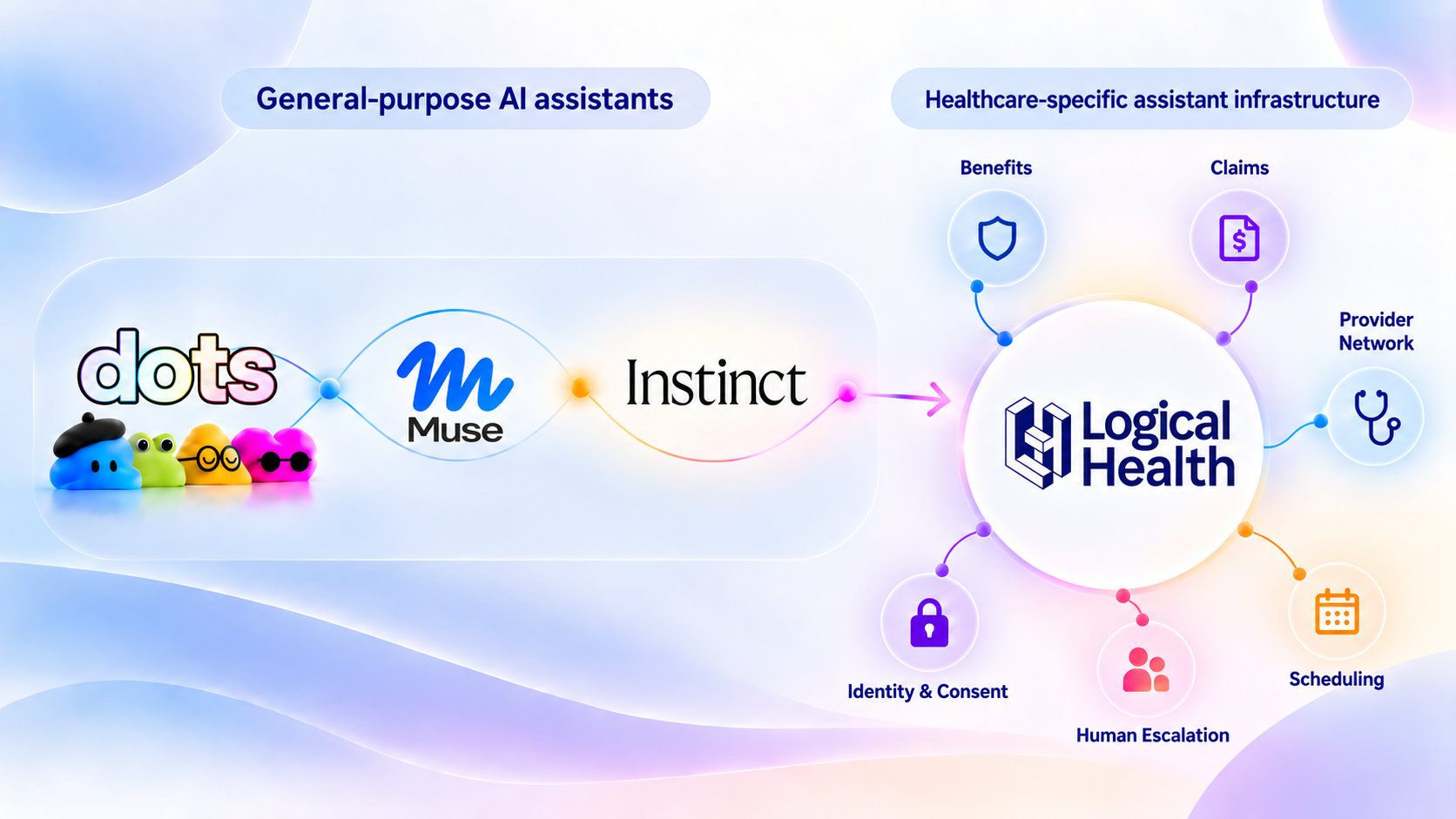
The year is 2030. UnitedHealthcare has had to shut down all phone systems and portals after autonomous AI assistants flood them with calls, logins, and retries. This future is very possible, but few healthcare executives are taking it seriously.
The same technology that creates this risk also creates an enormous opportunity. Personal AI assistants could finally solve healthcare’s $28B engagement problem by doing something much simpler than adding another portal, reminder, or incentive: making healthcare easier to navigate.
This is why healthcare companies need to give their members personal assistants that are connected to authoritative data, operate within clear permissions, and can actually get things done.
What are personal AI assistants?
In case you missed it, something important happened in consumer AI over the past month.
Meta launched Muse. OpenAI launched Dots. And Instinct raised $1 billion at a $10 billion valuation.
Different products, but the same underlying idea: AI is moving from something you ask questions to something that acts on your behalf.
These systems can browse the web, send messages, make calls, interact with software, and keep working after you walk away. They are not just smarter chatbots. They are early versions of personal assistants that can get things done in the real world.
Healthcare is already moving in this direction. Ferry Health recently launched an AI assistant that finds providers and contacts offices to schedule care. UnitedHealthcare's Avery can answer questions using a member's coverage and claims information and can call network primary care practices to schedule appointments.
The problem is that healthcare’s infrastructure was never built for millions of agents operating at machine speed.
What if healthcare does nothing?
If millions of consumers begin delegating healthcare tasks to AI agents, those agents will use whatever infrastructure already exists: portals, websites, email, and phone lines.
And software does not behave like a patient.
It can call five providers at once. Retry a failed request indefinitely. Recheck availability every few minutes. Escalate through multiple channels simultaneously.
We got an amusing preview when one Instinct user's agent reportedly made roughly 200 requests an hour to Resy while hunting for a restaurant reservation.
Now imagine that pattern applied to healthcare, multiplied by thousands or millions of members.
The result could be overwhelmed service channels, worse access for members, and eventually regulatory and legal exposure when people cannot get timely answers or care.
Healthcare has spent billions trying to get people to engage. Now people are finally engaging.
Meanwhile, there’s an entire industry built around patient and member engagement: portals, navigation apps, reminders, call centers, wellness platforms, rewards, incentives, and increasingly sophisticated outreach programs.
The global patient engagement solutions market was valued at $28 billion in 2025.
Yet the core problem has barely changed. Healthcare organizations are constantly trying to persuade people to engage on healthcare's terms.
“Download this app. Log into this portal. Call this number. Complete this screening. Earn this gift card. Collect these points.”
We keep dangling more incentives in front of people to get them to do the right thing.
But what if we just made healthcare easy?
Personal AI makes this possible. Patients can finally engage on their terms.
Consumers are voluntarily engaging with AI about their health at a scale healthcare organizations have spent years trying to create.
We should harness that behavior rather than fight it.
Give every member an assistant that can actually get things done
Imagine a member asks her personal assistant:
"I need a dermatologist. Can you find someone good who takes my insurance and book an appointment?"
Her agent is going to try.
Now imagine you are her health plan.
Would you rather that agent scrape a provider directory, guess which doctors are actually in network, and start calling offices?
Or would you rather give the member an assistant directly connected to authoritative information about her benefits, network, deductible, and care options?
That is the opportunity.
A healthcare-issued assistant has three major advantages.
First, it works better. It connects directly to the organization's authoritative systems. Instead of guessing from a PDF, it uses current benefit, claims, provider, and clinical information, with the appropriate permissions and controls.
Second, it can reduce the onslaught of outside AI. If members already have an easy way to get an accurate answer or complete a task, there is less reason for their general-purpose agents to scrape your portal, repeatedly traverse your IVR, or hammer your contact center.
Third, it can turn engagement into action.
If someone needs a mammogram, help her find an appropriate in-network facility and schedule it.
If a member on a high-deductible plan needs imaging, help him find an appropriate lower-cost option.
If a diabetic member appears overdue for recommended care, reach out and help remove the barriers to completing it.
This is where personal assistants become much more interesting than chatbots.
For years, healthcare has tried to get people to take the right actions by sending more messages, offering more rewards, and creating more programs.
What if instead we simply did more of the work for them?
My recommendation: embrace both sides of the agent economy
Healthcare organizations should do two things now.
Build an assistant for your members.
Not another FAQ bot. Give people an assistant capable of taking approved actions: finding care, booking appointments, understanding benefits, resolving administrative problems, and proactively helping them complete important healthcare tasks.
Make the easiest way to navigate your organization the assistant you provide, where you control the narrative.
At Logical Health, we’re helping healthcare companies do just that.
Then build a front door for everyone else's assistants.
Make it easy for an authorized Muse, Dot, Instinct, or whatever comes next to retrieve accurate information and complete permitted transactions without scraping your website or repeatedly calling your contact center. This means creating a way for authorized third-party agents to interact with them that are authenticated, permissioned, structured, and rate-limited.
This is not a chatbot build
Muse, Dots, and Instinct look simple because enormous complexity is hidden underneath.
Meta built a dedicated secure virtual machine for every Muse, plus a separate monitoring agent, credential isolation, permissions, and audit trails. OpenAI built Dots on top of GPT-6 Astra and cloud computers capable of operating browsers and software autonomously. Instinct just raised $1 billion to keep building its agent infrastructure, including calling, transactions, secure sandboxes, and credential management.
Now add healthcare: claims, benefits, provider directories, CDPs, portals, scheduling systems, identity, consent, HIPAA, clinical guardrails, and human escalation.
For most healthcare organizations, recreating that stack internally makes little sense.
How Logical Health can help
Logical Health helps healthcare companies launch their own AI personal assistants, without having to build the underlying agent infrastructure from scratch.
We provide the secure, compliant layer that connects AI agents to the systems healthcare already runs on: claims, benefits, provider networks, scheduling, care management, and other authoritative data sources.
That means healthcare organizations can give members assistants that don't just answer questions. Rather, they can understand each member's context, take approved actions on their behalf, and proactively help them navigate care.
Underneath, Logical Health handles the complexity required to operate safely in healthcare: identity, consent, permissions, security, clinical and operational guardrails, auditability, and human escalation.
Conclusion
At Logical Health, this is the bet we're making: the next healthcare interface is not another portal. It is a personal assistant that understands the member, understands the healthcare system, and can keep working until the task is actually done.
For years, healthcare has asked: How do we get members to engage?
In 2026, members are engaged. But will we let AI personal assistants overwhelm us, or will we capture the opportunity?
Done well, this is a rare opportunity to turn consumer adoption of AI into something healthcare has struggled to achieve for decades: better navigation, better care decisions, closed care gaps, lower costs, and less administrative friction.
The organizations that move first will not just improve engagement. They will shape how their members navigate healthcare in an agent-driven world.
When every member has an agent, will your organization be the system it trusts, or the system it has to fight through?
Ready to give your members a personal assistant?
Learn how Logical Health can connect personal assistants to your healthcare systems and help members get things done.
REQUEST DEMO